
Managing a fleet was not always as easy as it is today. Before GPS tracking systems were introduced, fleet owners had very limited visibility over their vehicles.
Most decisions were based on assumptions, manual reports, or delayed information. Because of this, managing costs, safety, and efficiency was a major challenge.
Understanding these problems helps explain why GPS solutions have become essential for fleet management today.
How Fleet Management Worked Before GPS Technology
Before GPS technology, fleet owners depended on:
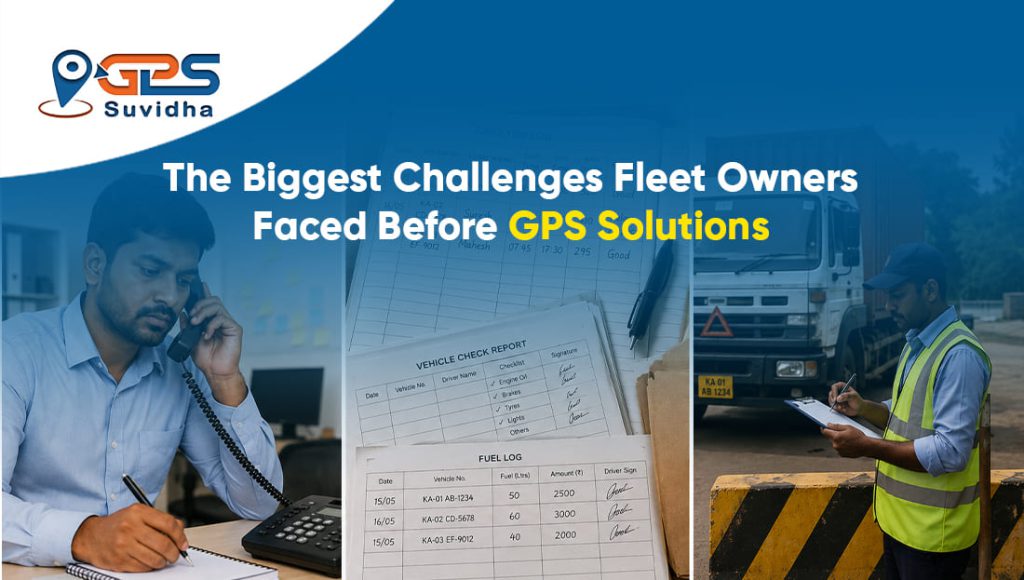
- Phone calls with drivers
- Paper-based logs and reports
- Checkpoints or manual updates
While these methods worked to some extent, they lacked accuracy and real-time visibility.
As a result, many problems were difficult to control.
The Biggest Challenges Fleet Owners Faced Before GPS
Lack of real-time visibility
One of the biggest challenges was not knowing where vehicles were at any given time.
Fleet managers had to call drivers for updates, which was not always reliable. Without real-time tracking, it was difficult to manage routes, delays, or unexpected situations.
Industry insights show that a lack of visibility leads to poor decision-making and operational inefficiencies in fleet management.
Poor route planning and delays
Without accurate location data, route planning was mostly based on experience or guesswork.
Drivers might take longer routes or face unexpected traffic, leading to:
- Delayed deliveries
- Increased fuel usage
- Reduced productivity
Without tracking tools, it was very difficult to optimize routes.
High fuel costs
Fuel has always been one of the biggest expenses for fleet owners.
Before GPS systems, there was no way to monitor:
- Fuel usage
- Idle time
- Unnecessary driving
Because of this, fuel wastage often went unnoticed.
Studies in fleet management show that a lack of monitoring leads to higher fuel consumption and increased operational costs.
No control over driver behavior
Driver behavior plays a major role in safety and cost.
However, before GPS tracking, fleet owners had no clear way to monitor how vehicles were being driven.
This led to issues like:
- Overspeeding
- Harsh driving
- Unsafe practices
Without data, improving driver performance was very difficult.
Delayed response during emergencies
In case of accidents, breakdowns, or theft, finding the exact location of a vehicle was a major challenge.
Without GPS, fleet owners had to depend on driver communication or the last known location.
This often caused delays in response, increasing both risk and loss.
Vehicle misuse and lack of accountability
Another common problem was vehicle misuse.
Since there was no tracking, vehicles could be used for unauthorized trips without the owner’s knowledge.
This resulted in:
- Increased fuel costs
- Higher maintenance expenses
- Reduced trust and accountability
Manual work and lack of data
Fleet management before GPS required a lot of manual work.
Managers had to maintain:
- Paper logs
- Manual reports
- Driver communication records
This process was time-consuming and often inaccurate.
Without proper data, making informed decisions was difficult.
Limited scalability
As fleet size increased, these problems became even bigger.
Managing a few vehicles manually was possible, but managing a large fleet without technology was extremely challenging.
This limited business growth and efficiency.
Also Read:- From Guesswork to Accuracy: How GPS Changed Vehicle Monitoring
Why GPS Solutions Changed Everything
GPS tracking solved most of these challenges by providing:
- Real-time vehicle visibility
- Accurate location data
- Route optimization
- Automated reports and insights
This allowed fleet owners to move from guesswork to data-driven management.
Why This is Important in India
In India, fleet owners face additional challenges such as:
- Heavy traffic
- Long-distance routes
- Rising fuel prices
- High vehicle usage
Because of these factors, managing a fleet without proper tracking becomes even more difficult.
GPS solutions help overcome these challenges by improving control and efficiency.
How GPS Suvidha Helps Solve These Challenges
Modern solutions like GPS Suvidha are designed to address all these problems.
With GPS Suvidha, fleet owners can:
- Track vehicles in real time
- Optimize routes
- Access clear reports and insights
This reduces manual work and helps improve efficiency and cost control.
Instead of relying on assumptions, fleet owners can make decisions based on real data.
Want to Overcome These Fleet Challenges?
If you want to avoid the limitations of traditional fleet management and move to a smarter system, using GPS tracking is a practical step.
With solutions like GPS Suvidha, you can manage your fleet more efficiently, reduce unnecessary costs, and improve overall performance.
Instead of dealing with uncertainty, you gain full visibility and control.
Frequently Asked Questions
The main challenges were a lack of real-time visibility, high fuel costs, poor route planning, and limited control over drivers.
Because it depended on manual processes and delayed information instead of real-time data.
GPS provides real-time tracking, accurate data, and automated insights, making fleet management more efficient.
Yes. Even small fleet owners can benefit from better control and reduced costs.