
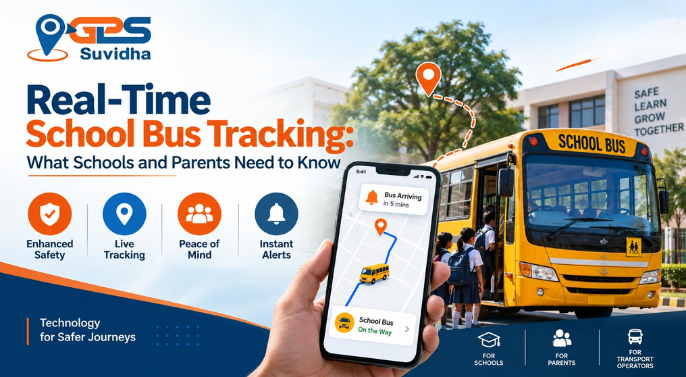
Every morning, millions of children across India step onto a school bus. And every morning, parents hand over a small but very real responsibility to a driver, a vehicle, and a route they cannot see. For years, that trust was based on habit. The bus usually comes on time. The driver is usually careful. The route usually stays the same. But “usually” is not a safety plan.
Real-time school bus tracking replaces that guesswork with certainty. It shows schools, transport operators, and parents exactly where a bus is right now, how it is being driven, and whether a child has boarded or gotten off safely. This guide covers how real-time tracking works, why it has become essential, what to look for in a good system, and how schools can roll it out smoothly.
What Is Real-Time School Bus Tracking?
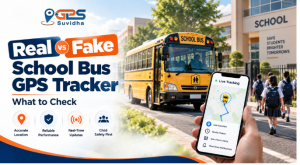
Real-time school bus tracking is a system built from three parts working together: a GPS device fitted inside the bus, a cloud-based dashboard for school administrators, and a mobile app for parents. Together, these turn a moving bus into something transparent and trackable instead of a black box that only reports back once the trip is over.
The GPS device constantly sends the bus’s location, speed, and route data to a central server. School transport coordinators watch this live on a map through their dashboard. Parents see a simpler version through an app, usually showing the bus’s current location, an estimated arrival time at their stop, and instant alerts when the bus is close by.
Some advanced systems, including GPS Suvidha’s Pick and Drop solution, go one step further. They track the child, not just the vehicle, using boarding confirmations or an in-bus camera to verify that a specific student actually got on and off the bus, rather than just confirming the bus passed a location.
Why Real-Time Tracking Has Become Essential for School Transport
A few years ago, GPS tracking on school buses was seen as a premium add-on offered mostly by large private schools. That is changing quickly, for a few clear reasons.
Parents already expect this level of visibility. People track food deliveries, cab rides, and courier packages in real time every day. It is a natural expectation that their child’s daily commute, arguably the most important trip of the day, should be at least as visible.
Safety incidents have pushed regulators to act. State transport authorities and school boards in several regions now recommend or require GPS tracking, speed governors, and CCTV in school transport vehicles, especially after accidents or long unexplained delays that left parents without any information.
Costs are under pressure. Fuel prices, driver salaries, and maintenance costs have all gone up. Schools and transport contractors need better route planning and clearer fuel usage data to keep bus services affordable without cutting corners on safety.
It signals a well-run school. For schools competing for admissions, a transparent, tech-enabled transport system has become a visible marker of institutional quality, in the same way smart classrooms or digital attendance systems are.
How Does Real-Time School Bus Tracking Work?
Understanding the mechanics helps schools evaluate vendors with a more critical eye. Here is the typical process, step by step.
- Installation. A compact GPS device is fitted in the bus, usually wired into the vehicle’s power supply for continuous operation, sometimes along with an RFID reader or camera for student identification.
- Data transmission. The device sends location, speed, and ignition status to a cloud server every few seconds over the mobile network.
- Processing and mapping. The server plots this data on a digital map, calculates estimated arrival times, and compares the bus’s actual route against its planned one.
- Alerting. If the bus deviates from its route, exceeds a speed limit, stops longer than expected, or enters or leaves a geo-fenced zone such as the school gate or a residential society, the system sends an automatic alert.
- Visibility. School admins see all of this on a management dashboard with MIS reports. Parents get a simplified live tracking view along with SMS or app notifications for pickup, drop-off, and anything unusual.
This is the same core technology used in commercial fleet management and logistics tracking, adapted for the safety-first, parent-facing needs of school transport.
Key Features to Look for in a Tracking System
Not every tracking system is built the same way. Schools evaluating vendors should look past the marketing language and check for these specific capabilities.
- Real-time GPS tracking on a live map, not delayed updates or a refresh-on-request view.
- Geo-fencing for the school, pickup and drop points, and any restricted zones, so the system flags it if the vehicle goes somewhere it should not.
- Route deviation and speed alerts sent immediately to both the school and the parent, not just logged for a later report.
- Student-level tracking through RFID cards, boarding confirmation, or an onboard camera, so the school can confirm which children actually boarded and got off, not just that the bus reached a stop.
- A parent-facing mobile app that keeps things simple: bus location, ETA, and alerts, without burying non-technical users in raw data.
- MIS and analytics reports covering route efficiency, driver behavior, fuel usage, and punctuality trends over time.
- Two-way communication tools that let schools push announcements, like a delay or route change, directly to parents instead of relying on a phone call chain.
- Reliable uptime and support, since a tracking system that goes down during peak hours defeats its own purpose.
Benefits for School Authorities
For school management and transport coordinators, real-time tracking changes daily operations in a few concrete ways.
Better accountability. Instead of relying on a driver’s word for why a bus was late, administrators can see the exact route taken, any unscheduled stops, and actual speed data. This discourages misuse of the vehicle for unauthorized trips.
Smarter route planning. Historical tracking data shows which routes run inefficiently, which stops cause repeated delays, and where buses are running near empty or overloaded, so transport managers can redesign routes to save both time and fuel.
Faster response to problems. If a bus breaks down, gets stuck in traffic, or goes off route, the school finds out immediately instead of hearing about it later through a wave of worried parent phone calls. A backup vehicle or a parent notification can go out within minutes.
Less administrative load. A large part of a transport coordinator’s day used to go toward answering “where is the bus” calls from anxious parents. A parent-facing app absorbs most of that traffic automatically, freeing staff for more useful work.
A documented safety record. For schools facing more regulatory scrutiny, a timestamped record of routes, speeds, and driver behavior is valuable for compliance reporting and, in rare cases, for investigating an incident.
Benefits for Parents
For parents, the value of real-time tracking is less about data and more about peace of mind.
Peace of mind. Knowing exactly where your child’s bus is at any moment removes a daily undercurrent of worry, especially for parents of younger kids or those living in cities with unpredictable traffic.
Fewer missed buses. Real-time ETA information lets parents time their arrival at the bus stop precisely, instead of standing outside for twenty minutes just in case, or worse, missing the bus altogether.
Alerts as they happen, not explanations after the fact. Instead of learning after the trip that the bus was forty minutes late, parents get a live notification the moment a delay or deviation occurs, often along with the reason.
Direct communication from the school. Two-way notification systems let schools inform every parent of a schedule change or emergency at the same time, instead of relying on word of mouth or an unofficial parent group chat.
Frequently Asked Questions
Basic systems only track the vehicle’s location. More advanced systems, like GPS Suvidha’s Pick and Drop app, also confirm individual student boarding and drop-off, giving schools and parents a clearer picture of a specific child’s journey rather than just the bus’s movement.
Cost depends on the number of vehicles, the features needed (basic location tracking versus student-level tracking with cameras and RFID), and whether hardware is purchased or leased. Most vendors offer a per-vehicle monthly subscription, which usually works out cheaper for schools than building something in-house.
Cost depends on the number of vehicles, the features needed (basic location tracking versus student-level tracking with cameras and RFID), and whether hardware is purchased or leased. Most vendors offer a per-vehicle monthly subscription, which usually works out cheaper for schools than building something in-house.
Most modern GPS devices store location data locally when the network drops and sync automatically once connectivity returns, so short network gaps do not create a total blackout in visibility.
Some initial resistance is common, but it usually fades once drivers understand that tracking data protects them too. It gives them an objective record in case of a false complaint or a delay genuinely caused by traffic, not carelessness.
Getting Started: What Schools Should Do Before Choosing a Vendor
- Map your current pain points. Is the core problem safety, punctuality, cost, or parent communication? The answer decides which features matter most.
- Involve transport staff early. Drivers and route coordinators will use the dashboard side every day, and their buy-in shapes how well the system actually gets used.
- Pilot it on a few buses first. Test the system on a handful of routes for a month before rolling it out across the whole fleet.
- Check how usable the parent app actually is. Ask a few parents to try it before full rollout. If it is confusing, adoption will stay low no matter how good the backend is.
- Review the depth of reporting. Make sure the MIS reports actually answer the operational questions your transport team needs, not just show a live map.
The Bottom Line
Real-time school bus tracking has moved from a nice-to-have feature to a baseline expectation for safe, well-run school transport. The technology itself is mature and reliable. The real decision for schools is choosing a system that combines accurate real-time tracking, meaningful alerts, an app parents will actually use, and reporting that genuinely improves how the transport team runs day to day.
GPS Suvidha’s School Bus Tracking solution is built around exactly this combination: real-time vehicle and student tracking, automatic alerts for route deviations and delays, and a simple Pick and Drop app that keeps parents informed without adding extra work for school staff. Learn more about our school bus tracking solution or get in touch with our team to discuss a pilot for your school’s fleet.