
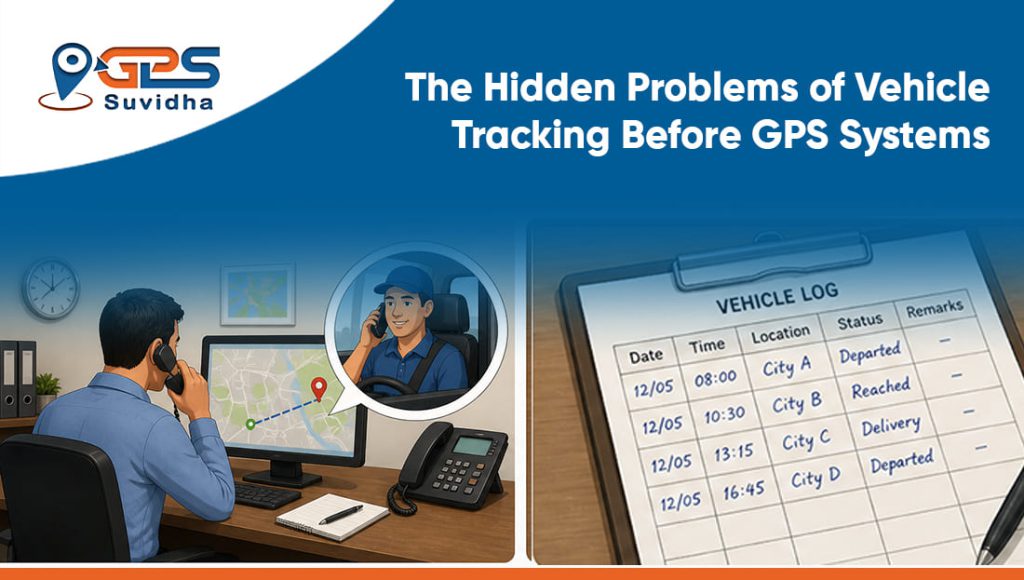
Today, tracking a vehicle in real time feels normal. You can open an app and instantly see where your vehicle is. However, this was not always possible.
Before GPS tracking systems became common, vehicle tracking was much more difficult, less accurate, and often unreliable. In many cases, businesses had to depend on guesswork, manual updates, or incomplete data.
Understanding these hidden problems helps explain why GPS tracking has become so important today.
How Vehicle Tracking Worked Before GPS
Before GPS systems, vehicle tracking depended on alternative methods such as:
- Phone calls with drivers
- Paper logs and manual reporting
- Cellular triangulation (using nearby mobile towers)
- RFID or short-range tracking systems
While these methods worked to some extent, they had serious limitations.
For example, cellular-based tracking could only provide an approximate location based on nearby towers, not the exact position.
Similarly, technologies like RFID and Bluetooth worked only in limited areas, such as warehouses or checkpoints, not for full-journey tracking.
The Hidden Problems of Vehicle Tracking Before GPS
1. No Real-Time Location Visibility
One of the biggest problems was the lack of real-time tracking.
In most cases, managers had to call drivers to ask their location. This created delays and uncertainty.
Without GPS, there was no live visibility of where a vehicle actually was, which made operations harder to manage.
2. Delayed Response During Emergencies
In case of accidents or breakdowns, quick response is very important.
However, without GPS tracking, it was difficult to find the exact location of a vehicle. As a result, help was often delayed.
This increased risks for drivers and also caused longer downtime for vehicles.
3. Inaccurate and Unreliable Location Data
Before GPS, most tracking methods could only give an estimated location.
For example:
- SIM-based tracking shows the nearest tower, not the exact position
- Wi-Fi or cellular tracking depends on network availability
Because of this, businesses often worked with incomplete or inaccurate data, which affected decision-making.
4. Limited Coverage and Dependency on Infrastructure
Another major issue was dependency on external systems, such as:
- Mobile towers
- RFID readers
- Wi-Fi networks
If these were not available, tracking simply did not work.
This made tracking especially difficult in rural areas or long-distance travel, where coverage was limited.
5. No Continuous Tracking
Most older tracking methods worked only at specific points.
For example:
- RFID works only when a vehicle passes a scanner
- Camera-based systems work only at checkpoints
This means there was no continuous journey tracking, only partial data.
As a result, businesses could not fully understand routes or delays.
6. No Vehicle Data or Performance Insights
Before GPS-based systems, tracking was mostly limited to basic location.
There was no access to important data like:
- Fuel usage
- Idle time
Modern GPS systems provide this data, but older methods could not.
7. High Dependency on Drivers
Without tracking systems, businesses had to rely heavily on drivers for updates.
Drivers had to:
- Report their location
- Share trip details
- Inform about delays
This created problems like:
- Miscommunication
- Incorrect reporting
- Lack of accountability
8. Fragmented and Incomplete Data
Without GPS, tracking data was often scattered.
Some vehicles might be tracked, while others were not. This created gaps in information and made it difficult to manage operations properly.
Incomplete visibility leads to poor decision-making and reduced efficiency.
Also Read:- Why GPS Tracking is Becoming Essential for Vehicle Safety
Why GPS Tracking Changed Everything
GPS tracking solved most of these problems by providing:
- Real-time location tracking
- Accurate positioning (within meters)
- Continuous monitoring
- Data insights (fuel, driving, routes)
As a result, businesses moved from guesswork to data-driven decisions.
Why This Matters in India
In India, these problems were even more challenging due to:
- Heavy traffic
- Large distances
- Network limitations in some areas
Without proper tracking, managing vehicles efficiently was very difficult.
This is why GPS tracking systems are now widely used across logistics, transport, and personal vehicle management.
How GPS Suvidha Solves These Problems
If you compare old tracking challenges with modern solutions, the difference becomes clear.
With GPS Suvidha, vehicle owners and businesses can:
- Track vehicles in real time
- Get accurate location data
- Access route history and reports
This removes the need for guesswork and manual tracking.
Instead, you get clear and reliable information that helps you manage vehicles more efficiently.
Want a Better Way to Track Your Vehicles?
If you want to avoid the limitations of older tracking methods and move to a smarter, more reliable system, solutions like GPS Suvidha can make a real difference.
Instead of depending on guesswork or delayed updates, you get real-time tracking, accurate location data, and complete visibility of your vehicle at all times. This means you always know where your vehicle is, how it is being used, and how efficiently it is operating.
In addition, it has easy-to-use features and a simple dashboard. You can quickly check routes, and make better decisions based on actual data.
As a result, you not only improve control but also reduce unnecessary costs, save time, and increase overall efficiency.
If you’re looking for a practical and easy solution to manage your vehicles smarter, GPS Suvidha helps you take that step with confidence.
Frequently Asked Questions
Vehicles were tracked using phone calls, manual logs, cellular triangulation, RFID systems, and other limited technologies.
The biggest problem was the lack of real-time and accurate location data.
No. Most methods provided only an approximate location and depended on external infrastructure.
GPS tracking provides real-time, accurate, and continuous data, along with additional insights like fuel usage.