
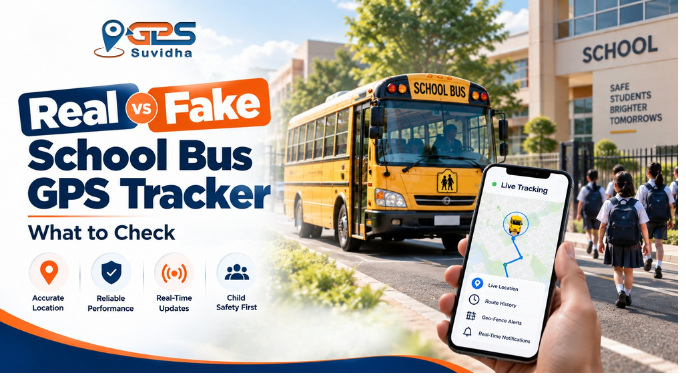
Every school wants to tell parents their buses are GPS tracked. It sounds reassuring on a brochure or a school website. But not every system that calls itself a school bus GPS tracker actually does what parents assume it does.
Some devices sold to schools are basic, low-accuracy locators dressed up with the word “GPS” in their name. Others genuinely track buses in real time and alert someone the moment a route goes wrong. The difference matters a lot more here than it does for most products, because the stakes involve children.
This guide walks through exactly what to check before a school signs up with a vendor, and what parents can reasonably ask their child’s school to confirm.
Why This Matters More for School Transport Than Almost Anything Else
A school bus carries dozens of children through traffic, across changing routes, and sometimes in low-visibility weather. If something goes wrong, whether that’s a wrong turn, an unscheduled stop, or a genuine emergency, minutes matter.
A school bus GPS tracker that updates every 20 or 30 minutes isn’t giving anyone real protection. By the time a delay or deviation shows up, the moment where quick action actually helps has often already passed. This is exactly why schools need to look past the label and check what’s actually inside the system.
5 Things Schools Should Check Before Choosing a GPS Tracker
- Confirm it uses real-time GPS, not delayed location pings. A genuine system for tracking school buses updates location every few seconds to a minute, not once every 15 to 30 minutes.
- Ask whether parents get live access, or just the school. Some systems only give administrators a dashboard, leaving parents with no direct visibility into where the bus actually is during the ride.
- Check for route deviation alerts. A real system flags it immediately if a bus goes off its assigned route, rather than only showing a map that someone has to actively watch.
- Look for independent battery backup on the device. If the tracker only works when the bus engine is running, it stops reporting the moment the vehicle is powered off, which is a real gap in coverage.
- Ask for a live demo before signing any contract. A legitimate vendor should be able to show the actual dashboard, the alert system, and how quickly location updates refresh, not just a sales presentation.
Signs a School Bus Tracking System May Not Be as Reliable as It Sounds
- Vague claims like “GPS enabled” without any mention of update frequency
- No parent-facing app or portal, only internal school access
- No clear explanation of what happens if the bus loses network signal
- Pricing that seems unusually low compared to other established vendors
- No willingness to provide a live demo before the contract is signed
- No dedicated support contact for technical issues once the system is installed
Genuine School Bus Tracking vs a Basic or Misleading System
| Factor | Genuine School Bus GPS Tracking | Basic or Misleading System |
| Update frequency | Every few seconds to a minute | Every 15 to 30 minutes, sometimes longer |
| Parent access | Live view through an app or portal | Often school-only, no parent visibility |
| Route alerts | Immediate deviation alerts | Passive map with no active alerting |
| Power backup | Independent battery included | Stops working if engine is off |
| Vendor support | Dedicated support and live demos | Minimal support after installation |
Questions Parents Can Reasonably Ask the School
Parents don’t need to become technical experts to ask good questions. It’s reasonable to ask whether the school bus tracking system updates in real time, whether parents get their own access to see the bus location, and what happens if the bus is delayed or takes an unexpected route.
If the school can’t clearly answer these questions, or if the answer is vague, that’s worth following up on directly. A school that has done proper due diligence on its vendor should have no trouble explaining how the system actually works.
Questions Schools Should Ask Before Signing a Vendor Contract
Beyond the basics, schools should ask about data privacy, how long location history is stored, and who has access to that data beyond school administrators. This matters just as much as the tracking accuracy itself.
It also helps to ask other schools using the same vendor about their actual experience, not just what the sales pitch promised. A system that looks good in a demo but struggles with real routes and real network conditions isn’t worth the investment.
A Realistic Scenario
Picture a school bus running late one afternoon due to unexpected road closures. With a genuine real-time tracking system, both the school transport coordinator and parents can see exactly where the bus is and get an estimated arrival time, reducing anxiety and unnecessary phone calls to the school office.
With a basic or delayed-update system, parents are left waiting without clear information, and the school has no early warning if the bus has gone off its usual route. The difference isn’t cosmetic, it directly affects how a difficult moment gets handled.
Why This Is Worth the Extra Diligence
Choosing a school bus GPS tracker isn’t like picking office software where a wrong choice just means some inconvenience. It’s a safety system that parents are trusting with their children’s daily commute. Taking the time to verify real-time accuracy, parent access, and reliable alerts isn’t excessive caution, it’s the baseline a school transport system should meet.
Getting Started
If your school is evaluating GPS tracking vendors, or if you’re a parent wanting to understand what your child’s school currently has in place, use the checklist above as a starting point for the conversation.
GPS Suvidha’s school bus tracking solution is built around real-time updates and parent visibility, designed specifically around the kind of reliability that school transport actually needs.
FAQs
Ask the school directly how often the location refreshes on their dashboard or app. If the answer is vague or the updates only happen every 15 to 30 minutes, it’s not a true real-time system, regardless of how it’s marketed.
Ideally yes. A genuine school bus tracking system usually offers parents live access through an app or web portal, not just internal visibility for school staff. If this isn’t available, it’s worth asking the school why.
A reliable tracking device stores location data locally and syncs once signal returns, so there’s still a complete record of the route even through short connectivity gaps, though live alerts depend on active signal.
Yes, and it’s often a good sign when a school proactively reviews its vendor rather than sticking with an outdated or unreliable system simply because it was installed years ago. Periodic review is reasonable practice.
Yes, that’s part of what makes it misleading. A basic device can still show a location, just less frequently or less accurately than parents assume, which is why checking update frequency specifically matters so much.
If the tracker only functions while the engine is on, it stops reporting the moment the bus is parked or turned off, creating a gap in coverage during exactly the periods when children may still be boarding or exiting the bus.
Final Takeaway
Choosing a school bus GPS tracker should never come down to the word “GPS” on a product brochure. Schools need to verify real-time updates, accurate location tracking, route deviation alerts, parent visibility, battery backup, and dependable vendor support before making a decision. Parents, too, have every right to ask how their child’s bus is being tracked and what happens when something goes wrong. A genuine tracking system should provide clear, timely information when it matters most—not simply show a bus icon on a map. Taking a few extra steps to verify these features can help schools build a safer, more transparent transport system for everyone.