
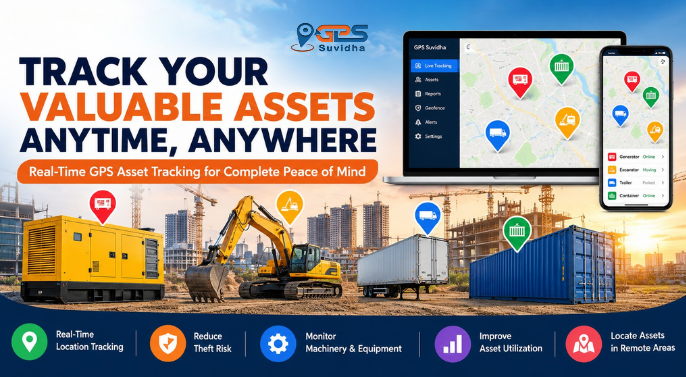
Your vehicles may already be tracked. But what about your generators, machinery, trailers and other valuable equipment?
Businesses often lose visibility over assets when they move between warehouses, construction sites, transport yards and customer locations. Manual registers and phone calls can help, but they do not always provide timely information about an asset’s location.
A GPS asset tracking system helps businesses monitor the location and movement of valuable physical assets using GPS-enabled tracking devices. Depending on the device and service configuration, businesses can check reported locations, review movement history and investigate unexpected movement.
GPS Suvidha provides GPS-based asset tracking solutions for businesses that need greater visibility over movable assets beyond conventional vehicle tracking.
Whether you manage construction equipment, generators, shipping containers, trailers or other valuable machinery, asset tracking can help you improve location visibility and make more informed operational decisions.
Looking for an asset tracking solution for your business? Explore the GPS Suvidha Asset Tracking service to discuss your tracking requirements.
What Is a GPS Asset Tracking System?
A GPS asset tracking system uses a tracking device and software to help businesses monitor the geographical location of movable assets.
The tracking device determines its position using satellite signals. It then sends location information through a supported communication network to a tracking platform, where authorised users can view available updates.
Unlike a manual asset register, GPS tracking can provide location information without requiring an employee to report every movement. The frequency and availability of updates depend on the device, connectivity and configuration.
For example, a construction company may use GPS asset tracking to locate a generator moved between project sites. A logistics business may use it to monitor a detached trailer in a transport yard. An equipment rental company may use it to check the latest reported location of machinery assigned to a customer.
The main objective is straightforward: know where your tracked assets are, identify unexpected movement and improve control over valuable equipment.
Why Do Businesses Need Asset Tracking?
An asset can be expensive to replace but difficult to supervise when it operates away from the main business premises.
Consider a company that owns several generators and compressors distributed across different construction sites. If a piece of equipment is moved without updating the asset register, the operations team may need to call multiple employees to establish its location.
The same problem can occur when trailers remain detached from trucks, containers move between depots or rented machinery is transferred between customer locations.
A suitable GPS asset tracking solution can help businesses address these challenges.
Reduce the risk of asset loss
Valuable equipment may be misplaced or moved without the owner’s knowledge. Location information can help teams establish where an asset was last reported and investigate unexpected movement.
GPS tracking does not guarantee theft prevention or recovery, but it can provide useful information when a business responds to a suspected loss.
Improve visibility across multiple sites
When equipment is spread across different locations, managers need a reliable way to check where tracked assets are located.
A tracking platform can help authorised users review reported locations without depending entirely on phone calls and manually updated spreadsheets.
Make better use of existing equipment
Businesses sometimes rent or purchase equipment because they cannot identify where their existing assets are located.
Improved location visibility can help managers check available resources before arranging another rental or purchase. However, location data alone cannot confirm whether equipment is operational, available or suitable for a particular task.
Coordinate asset transfers
Location updates can help teams coordinate the movement of trailers, machinery and other assets between warehouses, project sites and transport yards.
When an asset does not appear at its expected destination, the responsible team can investigate the delay and check the available movement information.
How Does GPS Asset Tracking Work?
A typical GPS asset tracking system works through four main stages.
1. Install a suitable tracking device
A GPS tracker is attached to or installed on the asset. For equipment without a convenient external power source, a battery-powered tracker may be suitable.
The device and mounting method should match the asset’s size, operating environment and expected movement pattern.
2. Determine the asset’s location
The tracker receives signals from navigation satellites to calculate its position. Satellite visibility, device placement and surrounding structures can affect positioning performance.
3. Transmit location information
The device sends location data through its supported communication network. Cellular connectivity is commonly used, although the communication method varies by device.
If network connectivity is unavailable, location updates may be delayed or unavailable until communication resumes, depending on the device’s capabilities.
4. View and use the available data
The tracking platform displays received location information to authorised users. Depending on the selected service, this may include map views, movement history, alerts or reports.
Businesses can use the information to check asset locations, investigate unexpected movement and coordinate operational activities.
Important: GPS positioning and data transmission are different processes. A device may determine its position but still be unable to send an update when its communication network is unavailable.
Which Assets Can You Track With GPS?
GPS asset tracking is suitable for many movable assets, provided the selected device supports the required installation and operating conditions.
Construction equipment and machinery
Construction companies use valuable equipment across temporary project locations. Examples include generators, compressors, excavators, loaders and other movable machinery.
Tracking can help site managers and operations teams check the latest reported locations of supported equipment and investigate unexpected movement between project sites.
Generators and portable power equipment
Generators are commonly used at construction sites, temporary facilities, events and remote work locations.
A battery-powered GPS tracker may be appropriate when the equipment does not have a suitable external power connection for a tracking device.
Businesses should confirm battery performance, mounting requirements and the availability of any additional monitoring features before selecting a tracker.
Trailers and logistics equipment
Detached trailers can remain in transport yards, warehouses, customer premises and temporary parking locations.
Tracking the tractor unit does not necessarily provide visibility over a trailer when it is disconnected. A separate asset tracking device can help businesses monitor the trailer’s latest reported position.
Shipping containers
Shipping containers move between depots, warehouses, ports and inland transport locations. Their movement may involve several organisations and handovers.
GPS tracking can help owners monitor the location of supported mobile containers. It does not automatically provide information about the condition of goods inside the container; environmental or cargo sensors may be needed for that purpose.
Agricultural equipment
Agricultural businesses may need to monitor tractors, portable pumps, generators and other valuable machinery across fields and storage locations.
When choosing a tracker, consider rural connectivity, mounting conditions, exposure to dust and moisture, and battery requirements.
Rental equipment
Equipment rental businesses need visibility over machinery assigned to customers and operating away from their premises.
GPS tracking can support location checks and investigations into unexpected movement. It should complement rental agreements, equipment handover records and return procedures rather than replace them.
Other movable business assets
Depending on the device, other suitable applications may include portable industrial equipment, mobile power units and selected high-value assets that move between locations.
GPS is not the best solution for every item. Small tools stored inside a warehouse may be easier to identify through barcodes, RFID or an indoor-location system.
Key Benefits of GPS Asset Tracking
Better location visibility
GPS asset tracking provides a way to check the latest reported locations of supported assets through a tracking interface.
This is useful when equipment moves frequently or is spread across multiple sites.
Support for theft investigations
Unexpected movement or location history may help businesses investigate a suspected theft or unauthorised transfer.
The device must remain operational and be able to provide location information for tracking to be useful. Recovery is never guaranteed.
Improved equipment allocation
Location visibility can help managers identify where equipment is located before arranging a transfer, rental or purchase.
Combining tracking data with maintenance records and availability information can support better resource planning.
More efficient coordination
Teams can use location updates to coordinate asset transfers and investigate delays.
For example, a warehouse supervisor may check whether a tracked trailer has reached its expected destination before contacting the transport team.
Stronger asset management processes
Tracking information can complement asset registers, equipment handover records and maintenance schedules.
It gives businesses another source of information when reviewing where equipment should be and who is responsible for it.
Better planning across multiple locations
Companies with several branches or project sites can use location information to review how their assets are distributed.
This may help identify opportunities to move underused equipment to a location where it is needed.
GPS Asset Tracking vs. Vehicle Tracking
GPS asset tracking and vehicle tracking use similar positioning technology, but they serve different operational requirements.
| Feature | GPS asset tracking | Vehicle tracking |
| Main purpose | Monitor movable assets and equipment | Monitor vehicles and journeys |
| Examples | Generators, containers, detached trailers, machinery | Trucks, cars, buses and vans |
| Power source | May use an internal battery or external power | Commonly uses vehicle electrical power |
| Main focus | Asset location and movement | Vehicle location, routes and trip activity |
| Typical users | Asset owners, site managers and rental businesses | Fleet managers and transport operators |
A business that operates trucks and detached trailers may benefit from both solutions. Vehicle tracking helps monitor the truck, while a separate tracker can provide visibility over the trailer when it is disconnected.
If your business also needs vehicle monitoring, explore the GPS Suvidha Fleet Management service.
Features to Evaluate Before Choosing an Asset Tracker
Not every device supports the same features. Confirm the specifications and service inclusions before purchasing.
Location update frequency
Ask how often the tracker reports its location and whether the reporting interval can be configured.
Frequent updates may be important for mobile assets, while equipment that remains stationary for long periods may need a different reporting pattern.
Movement notifications
Movement alerts may help identify when an asset begins moving or is moved outside an expected period.
Check which events the selected device can detect and whether notifications are included in the service.
Geofencing
Geofencing uses virtual boundaries around defined geographical areas. If supported, it can notify authorised users when an asset enters or leaves a designated zone.
This can be useful for equipment expected to remain within a warehouse yard, construction site or transport depot.
Location history and reports
Location history can help teams review previous reported positions and investigate movement.
Check the record-retention period, report availability and whether data can be exported for internal reviews.
Battery life
Battery life depends on battery capacity, reporting frequency, network conditions, temperature and device settings.
Ask for expected battery performance under your intended operating conditions rather than relying on a single general figure.
Durability and installation
Assets used outdoors may need protection against dust, moisture, vibration and temperature changes.
Check the device’s documented environmental ratings, mounting options and compatibility with the equipment.
Network coverage
GPS determines position, while a communication network generally transmits updates to the tracking platform.
Assess network availability in the locations where your assets operate, especially rural sites, enclosed storage areas and remote construction locations.
Dashboard and user access
Check whether the tracking interface is easy to use and supports the number of assets and users your business requires.
Confirm the availability of mobile access, alerts, reports and user permissions rather than assuming every feature is included.
How to Choose the Right GPS Asset Tracking System in India
Choosing the right solution starts with your operational needs.
Step 1: List the assets you want to track. Record asset type, approximate value, usual location, movement frequency and power availability.
Step 2: Define your main objective. Decide whether you need location visibility, movement alerts, support for theft investigations or better coordination across sites.
Step 3: Check installation and power requirements. Determine whether a battery-powered device is appropriate or whether an external power connection is available.
Step 4: Review reporting and connectivity. Ask how often location updates are provided and how the device behaves when network coverage is limited.
Step 5: Compare features and costs. Review hardware, installation, communication, subscriptions, maintenance and any additional services.
Step 6: Test the solution. If practical, start with a small group of assets to evaluate performance under real operating conditions.
Step 7: Establish a response process. Assign responsibility for alerts and make sure staff know how to investigate unexpected movement.
A pilot deployment can reveal installation issues and coverage limitations before you invest in a larger rollout.
What Affects the Cost of GPS Asset Tracking in India?
The cost of an asset tracking solution varies according to the device, asset type, connectivity and required service features.
Common cost factors include:
- Hardware: Device type, battery capacity, durability and supported functions.
- Installation: Mounting requirements and installation complexity.
- Connectivity: The communication service used to transmit location updates.
- Subscription: Access to the tracking dashboard, reports and supported alerts.
- Maintenance: Battery replacement, servicing and hardware replacement where applicable.
- Deployment size: Number of assets and users.
- Additional requirements: Specialised sensors, extended data retention or custom reporting, if offered.
When requesting a quotation, provide the number and types of assets, their operating locations, power requirements and the reporting frequency you need.
Ask the provider to separate one-time costs from recurring charges. This makes it easier to compare the total cost of ownership rather than choosing solely on initial hardware price.
Why Consider GPS Suvidha for Asset Tracking?
GPS Suvidha offers a dedicated Asset Tracking service for businesses that need GPS-based visibility over valuable assets beyond conventional vehicles.
Its published service information highlights the use of GPS trackers with internal batteries for monitoring assets away from business premises. The page also identifies asset location visibility, theft-risk reduction and locating assets in remote areas as relevant benefits.
When discussing your requirements with GPS Suvidha, explain:
- Which assets you want to monitor, such as generators, machinery or trailers.
- Whether the assets have an external power source.
- Where the assets normally operate.
- How frequently you need location updates.
- Whether you require movement notifications, geofencing or location history.
- How many assets you plan to track.
- Your installation, maintenance and budget requirements.
These details can help establish whether the available device and service configuration fits your use case.
Businesses that also need vehicle monitoring can explore GPS Suvidha Fleet Management. For other tracking requirements, visit the GPS Suvidha website.
Confirm the availability of specific device features, coverage, pricing and service terms directly with the provider before making a purchase decision.
Frequently Asked Questions About GPS Asset Tracking
{ “@context”: “https://schema.org”, “@type”: “FAQPage”, “mainEntity”: [ { “@type”: “Question”, “name”: “What is a GPS asset tracking system?”, “acceptedAnswer”: { “@type”: “Answer”, “text”: “A GPS asset tracking system uses a GPS-enabled device and tracking software to monitor the location and movement of physical assets. Businesses use it to locate equipment, investigate unexpected movement and improve visibility across multiple sites.” } }, { “@type”: “Question”, “name”: “Can I track a generator without a vehicle battery?”, “acceptedAnswer”: { “@type”: “Answer”, “text”: “Yes. A battery-powered GPS tracker may be suitable for a generator or other asset without a convenient external power source. Battery life and reporting frequency depend on the selected device and its configuration.” } }, { “@type”: “Question”, “name”: “Which assets can be tracked using GPS?”, “acceptedAnswer”: { “@type”: “Answer”, “text”: “Depending on the device and installation requirements, suitable assets may include generators, construction machinery, trailers, shipping containers, agricultural equipment and portable industrial equipment.” } }, { “@type”: “Question”, “name”: “What is the difference between GPS asset tracking and vehicle tracking?”, “acceptedAnswer”: { “@type”: “Answer”, “text”: “Vehicle tracking focuses on vehicles and their journeys. Asset tracking focuses on movable equipment that may not have its own engine or permanent power connection, such as generators, detached trailers and containers.” } }, { “@type”: “Question”, “name”: “Can GPS asset tracking help recover stolen equipment?”, “acceptedAnswer”: { “@type”: “Answer”, “text”: “A functioning tracker may provide location information that helps the owner investigate a suspected theft and coordinate with the relevant authorities. Recovery depends on device operation, connectivity and the circumstances of the incident; it is not guaranteed.” } }, { “@type”: “Question”, “name”: “Does GPS asset tracking work in remote areas?”, “acceptedAnswer”: { “@type”: “Answer”, “text”: “GPS positioning may work in many remote locations, but transmitting updates to a dashboard generally requires a supported communication network. Limited connectivity can delay or prevent updates.” } }, { “@type”: “Question”, “name”: “How long does a battery-powered GPS tracker last?”, “acceptedAnswer”: { “@type”: “Answer”, “text”: “Battery life varies with battery capacity, reporting frequency, connectivity, temperature and device settings. Ask the provider for expected performance under your specific operating conditions.” } }, { “@type”: “Question”, “name”: “Can I monitor multiple assets from one dashboard?”, “acceptedAnswer”: { “@type”: “Answer”, “text”: “Many asset tracking platforms support multiple devices through a shared dashboard. Confirm the supported device count, user access, reporting features and subscription terms with the provider.” } }, { “@type”: “Question”, “name”: “Does GPS asset tracking provide real-time updates?”, “acceptedAnswer”: { “@type”: “Answer”, “text”: “Update frequency depends on the tracker, its configuration and network availability. Ask the provider what reporting intervals are supported and whether delays can occur in low-connectivity locations.” } }, { “@type”: “Question”, “name”: “What is geofencing in asset tracking?”, “acceptedAnswer”: { “@type”: “Answer”, “text”: “Geofencing creates a virtual boundary around a geographical area. When supported, the system can notify authorised users when a tracked asset enters or leaves the defined zone.” } }, { “@type”: “Question”, “name”: “Is GPS asset tracking suitable for construction companies?”, “acceptedAnswer”: { “@type”: “Answer”, “text”: “It can help construction businesses monitor the location of supported machinery and equipment across project sites. Device durability, mounting, power supply and network coverage should be checked before deployment.” } }, { “@type”: “Question”, “name”: “Is GPS better than RFID for asset tracking?”, “acceptedAnswer”: { “@type”: “Answer”, “text”: “Neither technology is best for every situation. GPS is generally useful for monitoring mobile assets across wider geographical areas. RFID can be more suitable for identifying items during inventory checks within controlled locations.” } }, { “@type”: “Question”, “name”: “How much does GPS asset tracking cost in India?”, “acceptedAnswer”: { “@type”: “Answer”, “text”: “Pricing depends on hardware, installation, connectivity, subscriptions, maintenance and required features. Request a quotation based on your asset types, quantity and operational requirements.” } }, { “@type”: “Question”, “name”: “How do I choose the best GPS asset tracking provider?”, “acceptedAnswer”: { “@type”: “Answer”, “text”: “Compare device compatibility, battery performance, update frequency, connectivity, available reports, support and total cost. Ask for a demonstration and test the solution before deploying it across all your assets.” } }, { “@type”: “Question”, “name”: “Can GPS tracking monitor the condition of goods inside a container?”, “acceptedAnswer”: { “@type”: “Answer”, “text”: “Location tracking alone does not establish the condition of goods inside a container. Temperature, humidity or door-status monitoring may require additional sensors and compatible services.” } } ] }1. What is a GPS asset tracking system?
A GPS asset tracking system uses a GPS-enabled device and tracking software to monitor the location and movement of physical assets. Businesses use it to locate equipment, investigate unexpected movement and improve visibility across multiple sites.
2. Can I track a generator without a vehicle battery?
Yes. A battery-powered GPS tracker may be suitable for a generator or other asset without a convenient external power source. Battery life and reporting frequency depend on the selected device and its configuration.
3. Which assets can be tracked using GPS?
Depending on the device and installation requirements, suitable assets may include generators, construction machinery, trailers, shipping containers, agricultural equipment and portable industrial equipment.
4. What is the difference between GPS asset tracking and vehicle tracking?
Vehicle tracking focuses on vehicles and their journeys. Asset tracking focuses on movable equipment that may not have its own engine or permanent power connection, such as generators, detached trailers and containers.
5. Can GPS asset tracking help recover stolen equipment?
A functioning tracker may provide location information that helps the owner investigate a suspected theft and coordinate with the relevant authorities. Recovery depends on device operation, connectivity and the circumstances of the incident; it is not guaranteed.
6. Does GPS asset tracking work in remote areas?
GPS positioning may work in many remote locations, but transmitting updates to a dashboard generally requires a supported communication network. Limited connectivity can delay or prevent updates.
7. How long does a battery-powered GPS tracker last?
Battery life varies with battery capacity, reporting frequency, connectivity, temperature and device settings. Ask the provider for expected performance under your specific operating conditions.
8. Can I monitor multiple assets from one dashboard?
Many asset tracking platforms support multiple devices through a shared dashboard. Confirm the supported device count, user access, reporting features and subscription terms with the provider.
9. Does GPS asset tracking provide real-time updates?
Update frequency depends on the tracker, its configuration and network availability. Ask the provider what reporting intervals are supported and whether delays can occur in low-connectivity locations.
10. What is geofencing in asset tracking?
Geofencing creates a virtual boundary around a geographical area. When supported, the system can notify authorised users when a tracked asset enters or leaves the defined zone.
11. Is GPS asset tracking suitable for construction companies?
It can help construction businesses monitor the location of supported machinery and equipment across project sites. Device durability, mounting, power supply and network coverage should be checked before deployment.
12. Is GPS better than RFID for asset tracking?
Neither technology is best for every situation. GPS is generally useful for monitoring mobile assets across wider geographical areas. RFID can be more suitable for identifying items during inventory checks within controlled locations.
13. How much does GPS asset tracking cost in India?
Pricing depends on hardware, installation, connectivity, subscriptions, maintenance and required features. Request a quotation based on your asset types, quantity and operational requirements.
14. How do I choose the best GPS asset tracking provider?
Compare device compatibility, battery performance, update frequency, connectivity, available reports, support and total cost. Ask for a demonstration and test the solution before deploying it across all your assets.
15. Can GPS tracking monitor the condition of goods inside a container?
Location tracking alone does not establish the condition of goods inside a container. Temperature, humidity or door-status monitoring may require additional sensors and compatible services.
Improve Asset Visibility With GPS Suvidha
When equipment moves between warehouses, project sites, transport yards and customer locations, knowing its last reported position can make asset management easier.
A suitable GPS asset tracking system can help businesses monitor supported assets, investigate unexpected movement, coordinate equipment transfers and make more informed decisions about resource allocation.
The right solution depends on the type of asset, power supply, operating environment, connectivity and required features.
Want to monitor your valuable equipment? Visit the GPS Suvidha Asset Tracking service page to explore the service and discuss your business requirements.