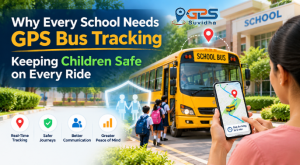

Managing school transportation is about much more than ensuring that buses arrive at the school gate on time. Every day, school administrators and transport managers must coordinate vehicles, drivers, pickup points, student schedules, traffic conditions and parent communication.
At the same time, schools need to manage rising fuel expenses, vehicle maintenance, driver salaries and other transportation costs without compromising student safety.
This is where school bus tracking can make a meaningful difference.
A GPS-based school bus tracking system gives schools real-time visibility into vehicle locations, routes and journey progress. When combined with route history, management reports, route-deviation alerts and effective transport planning, it can help schools identify unnecessary travel, improve vehicle utilisation and make more informed operating decisions.
Instead of relying only on fixed routes and manual records, school transport managers can use actual journey data to understand what is happening on the road and where improvements are possible.
For Indian schools operating in busy cities, growing residential areas and locations with unpredictable traffic, this information can be particularly useful.
In this guide, we explore how school bus tracking helps schools optimise routes, control transportation expenses, improve operational efficiency and build a more reliable school transport system.
What Is School Bus Tracking?
School bus tracking is a technology-based system that allows authorised users to monitor school buses using GPS-enabled devices, tracking software and connected web or mobile applications.
Depending on the system, it can display a bus’s current location, assigned route, movement, journey history and other operational information.
A school administrator may use a central dashboard to monitor multiple buses, while parents may receive access to a mobile application or notifications that provide relevant pickup and drop-off updates.
Modern school bus tracking solutions may also offer:
- Real-time bus location on a digital map.
- Route monitoring and deviation alerts.
- Pickup and drop-off notifications.
- Geofencing for selected locations.
- Reports on journey timings and driving patterns.
- Notifications about breakdowns or other unexpected events.
- Student boarding or travel-status features, where supported.
GPS Suvidha’s School Bus Tracking solution includes live bus monitoring, route-deviation alerts, management information system (MIS) reports, route-planning support and parent notifications.
However, tracking a bus and optimising its route are not exactly the same thing.
Tracking tells a school where a bus is and how it has travelled. Route optimisation uses that information, together with student locations, road conditions, school timings and vehicle capacity, to determine whether the existing route can be improved.
The greatest operational value comes when schools use tracking information to make regular, evidence-based decisions rather than simply viewing bus locations on a map.
Why Are School Transportation Costs Increasing?
School transportation involves several recurring expenses. Even when a school already has established routes, those routes may become less efficient as student enrolment, residential developments and traffic patterns change.
Understanding the major cost drivers is the first step towards controlling them.
1. Rising fuel expenses
Fuel is one of the most visible costs of operating school buses.
A bus that travels longer distances than necessary consumes more fuel. Repeated diversions, avoidable waiting with the engine running, overlapping routes and unnecessary trips can add to operating expenses.
For example, if two buses travel through the same residential area to collect students who could be served through a better-coordinated route, the school may be paying for avoidable kilometres.
GPS tracking helps managers review actual distances travelled and identify journeys that deserve closer examination.
2. Inefficient route planning
Some school routes remain unchanged for years, even when the number and location of students have changed.
A route that worked well when a school opened may no longer be suitable after new housing societies develop or students move to different neighbourhoods.
Without reviewing actual travel patterns, transport managers may continue using routes that involve unnecessary backtracking, repeated road crossings or long gaps between pickup points.
3. Traffic-related delays
Indian school buses frequently operate in areas affected by congestion, road construction, narrow streets and peak-hour traffic.
A route that appears short on a map may take longer than expected during school departure hours.
Repeated delays can lead to changes in departure schedules, longer driver duty periods and difficulties coordinating multiple buses.
Tracking data helps schools understand where delays occur regularly and whether a different road sequence or departure time would be more suitable.
4. Poor vehicle utilisation
A school may operate several buses without having a clear picture of how efficiently each vehicle is being used.
Some buses may travel long distances while carrying relatively few students, while others may have more efficient routes or better-balanced passenger loads.
Vehicle utilisation must always respect the applicable seating capacity and student safety requirements. However, where capacity and schedules permit, schools can assess whether routes or vehicle assignments should be adjusted.
5. Administrative workload
When a school does not have reliable tracking information, staff may spend considerable time calling drivers, responding to parent enquiries, confirming delays and investigating complaints.
This creates additional administrative work and reduces the time available for other school operations.
A tracking dashboard and timely notifications can help staff answer routine questions more efficiently.
The aim is not simply to reduce expenditure. It is to use the school’s available transportation resources more effectively while maintaining safe, dependable service for students.
How GPS Tracking Helps Optimise School Bus Routes
Route optimisation is one of the most practical applications of school bus tracking. It involves examining how buses travel, where they stop, how long journeys take and whether the current arrangements meet the school’s requirements.
Here are the main ways GPS tracking supports this process.
1. Identifying overlapping bus routes
When a school operates multiple buses, some routes may cover the same streets or residential areas.
A certain amount of overlap may be necessary because of student locations, road layouts or different school timings. However, unnecessary overlap can increase total distance travelled and fuel consumption.
With historical route data, transport managers can compare the paths followed by different buses and identify areas where routes may be coordinated more effectively.
For example, imagine a school with two buses serving nearby residential societies. Both buses may travel along the same main road before taking different turns into their assigned areas.
A review might reveal that the pickup sequence can be adjusted to reduce backtracking. Alternatively, one bus may be able to serve a group of stops more efficiently, provided its capacity, timing and approved route allow it.
The benefit: Schools gain a clearer understanding of where routes overlap and can evaluate whether changes would reduce unnecessary travel without creating longer journeys for students.
2. Reducing unnecessary kilometres
A route may look efficient on paper but turn out differently in real-world conditions.
Drivers may encounter road closures, make diversions or travel along roads that add distance without providing any operational benefit.
A GPS school bus tracking system can help administrators compare planned routes with actual journeys.
By reviewing these differences, schools can investigate questions such as:
- Is the bus repeatedly taking a longer road?
- Are certain diversions avoidable?
- Does the route involve unnecessary backtracking?
- Are pickup points arranged in a logical sequence?
- Is the distance travelled consistent with the approved route?
Not every deviation indicates a problem. Road safety, congestion, construction and emergencies can make a different route necessary.
The purpose of route monitoring is to understand why deviations occur and make sensible adjustments where possible.
Over time, reducing unnecessary kilometres can help lower fuel use, tyre wear and other distance-related vehicle expenses.
3. Improving pickup and drop-off schedules
An efficient route must consider time as well as distance.
A bus may cover a relatively short distance but still run late because its pickup sequence does not account for traffic patterns, school opening times or the time required for students to board.
Tracking systems help schools compare planned and actual journey timings.
Suppose a bus regularly reaches a particular residential area later than expected. The transport manager can review the journey history to determine whether the problem comes from congestion, the pickup sequence, excessive waiting or an unrealistic schedule.
The school can then consider practical changes, such as adjusting the departure time, reviewing the stop sequence or communicating a more realistic pickup window.
A better schedule can help students spend less time waiting at stops and reduce the pressure on drivers to make up lost time.
Importantly, schedules should be designed around safe driving and realistic travel conditions, not unrealistic expectations of speed.
4. Using historical GPS data to improve routes
One day’s journey does not always reveal the full picture.
Traffic conditions change from day to day, and a road that is usually efficient may become congested because of construction, weather or local events.
Historical GPS information allows transport managers to compare journeys across multiple days and identify recurring patterns.
They can examine:
- Average journey duration.
- Actual distance travelled.
- Repeated delays at specific locations.
- Stops that consistently take longer than expected.
- Differences between planned and actual routes.
- Recurring deviations and unexpected detours.
For instance, if a bus regularly loses time near a busy market during morning school hours, the school can investigate whether an alternative road is practical.
If the same delay occurs only on certain days, a permanent route change may not be necessary. A temporary adjustment or revised departure time may be more appropriate.
The key advantage is that decisions can be based on observed journey patterns instead of assumptions.
5. Choosing suitable routes for local road conditions
The shortest route is not automatically the best route for a school bus.
A road may be narrow, poorly maintained, congested or unsuitable for a large vehicle. Another road may be slightly longer but offer safer turning points, better road conditions and more predictable travel times.
Route planning should therefore balance distance, duration, road suitability and student safety.
In Indian cities, this can mean considering the location of residential gates, school zones, railway crossings, market areas and roads with heavy morning traffic.
GPS tracking helps managers understand how long buses spend on different parts of their journeys. That information can support a route review, although managers must also assess road conditions and safety factors that GPS data alone cannot determine.
The best route is one that meets the school’s transport requirements safely and reliably, not necessarily the one with the fewest kilometres.
6. Monitoring route deviations
Unexpected route changes can affect arrival times, increase journey distance and make it harder for school staff to understand a bus’s progress.
Route-deviation alerts help authorised staff identify when a vehicle moves away from its assigned route, where that feature is supported and correctly configured.
The transport manager can then determine whether the deviation resulted from congestion, a road closure, an emergency or an unauthorised change.
This distinction matters. A legitimate diversion should not automatically be treated as misconduct.
When used appropriately, route-deviation monitoring supports better accountability, faster communication and more accurate journey records.
It can also help the school identify routes that repeatedly require adjustments, indicating that the original plan may need to be reviewed.
7. Coordinating multiple buses more effectively
Schools with large transport fleets must coordinate several vehicles, drivers, routes and schedules at the same time.
Without a central view, managers may struggle to determine which buses have started their journeys, which are delayed and which have completed their routes.
A central tracking dashboard can make it easier to monitor multiple vehicles and respond to operational issues.
For example, if one bus experiences a breakdown, the transport team can quickly identify its location and assess the situation. Any replacement or rerouting decision must then account for vehicle capacity, student safety and the school’s operating procedures.
Centralised monitoring also helps management compare the performance of different routes and identify where additional attention is needed.
8. Reviewing routes after enrolment changes
School transport requirements are not fixed.
Students may join or leave the school, families may move to new neighbourhoods, and demand may increase in particular residential areas.
When these changes occur, the school should review whether the existing route structure still makes sense.
Combining student address information with GPS journey records helps transport managers identify routes that may need adjustment.
For example, a school may discover that several new students live near an existing bus route. Depending on capacity, pickup times and safety considerations, adding an appropriate stop may be more efficient than creating a separate route.
Similarly, if student numbers decline in a particular area, the school can assess whether the route needs restructuring.
Regular reviews help prevent yesterday’s transport plan from becoming tomorrow’s unnecessary expense.
8 Ways School Bus Tracking Helps Reduce Transportation Costs
Route optimisation can contribute to cost control, but it is only one part of an efficient school transportation system. GPS tracking can also help schools improve vehicle use, reduce avoidable delays and manage daily operations with better information.
1. Controlling fuel consumption
When buses travel unnecessary kilometres, schools may spend more on fuel than required.
Tracking systems help administrators examine distances travelled, route deviations and recurring delays. If the system provides suitable vehicle data, schools may also be able to review idling or engine-use patterns.
For example, a bus that regularly takes a longer route to reach the same set of stops may be a candidate for route review.
Schools can compare fuel records with kilometres travelled to identify unusual changes and investigate possible causes.
However, GPS tracking does not automatically guarantee fuel savings. Results depend on whether the school identifies inefficiencies and implements effective changes.
2. Reducing vehicle wear and maintenance expenses
The cost of operating a school bus includes more than fuel.
Frequent long-distance travel, unnecessary detours and poorly planned journeys can increase wear on tyres, brakes and other vehicle components.
By identifying avoidable travel and monitoring vehicle usage, schools can make better-informed decisions about route planning and maintenance scheduling.
Historical trip information can also help managers understand how intensively each bus is being used.
These insights do not replace professional vehicle inspections or scheduled servicing. Instead, they provide additional operational information that supports maintenance planning.
3. Improving the use of existing buses
Adding another bus may seem like the easiest way to solve a transport problem, but it can introduce additional expenses, including driver salaries, insurance, maintenance and fuel.
Before expanding the fleet, a school can review its existing routes to determine whether the current vehicles are being used effectively.
GPS records can help managers identify unnecessary overlap, long empty movements and routes that may be reorganised.
Where there is sufficient capacity and the timetable permits, a more efficient allocation of vehicles may help the school meet demand without immediately adding another bus.
This must be done carefully. A vehicle should never exceed its authorised capacity, and student travel times and safety must remain acceptable.
4. Reducing unnecessary administrative work
Without reliable vehicle information, transport coordinators may repeatedly contact drivers to confirm locations and arrival times.
Parents may also call the school office whenever a bus is delayed.
Live tracking and automated notifications can reduce the need for these routine enquiries by making relevant information available to authorised users.
For example, a parent may receive a notification that the bus is approaching the pickup point instead of calling the school to ask where it is.
This can free up staff time for route coordination, student support and other responsibilities.
The financial benefit may not appear as a direct reduction in fuel bills, but lower administrative workload can improve the overall efficiency of school operations.
5. Minimising avoidable delays and overtime
Longer-than-planned journeys can affect driver schedules and create difficulties when vehicles have to complete multiple trips.
Tracking data helps schools identify recurring delay patterns and determine whether they are related to route planning, congestion, excessive stop times or other factors.
Managers can then adjust schedules where practical.
For instance, if a bus regularly reaches school late because its first few stops are arranged inefficiently, a revised sequence may improve punctuality.
Any reduction in overtime or additional operating hours will depend on the school’s staffing arrangements and whether the revised schedule genuinely reduces working time.
6. Improving accountability for drivers and transport contractors
Schools that outsource transportation may need to verify whether contracted buses follow agreed routes and schedules.
GPS records can help administrators review actual journeys, check route adherence and investigate discrepancies.
This creates a more transparent basis for discussions with transport providers.
For example, if a contractor reports repeated delays, the school can review the journey history before deciding whether the issue relates to traffic, scheduling or another operational factor.
Accurate records also help schools evaluate whether agreed service standards are being met.
The objective should be fair, evidence-based oversight rather than penalising drivers for legitimate road conditions or safety-related decisions.
7. Supporting better transport budgeting
A transport budget becomes more useful when it reflects actual operating conditions.
GPS tracking reports can help schools understand the distances covered by individual buses, journey durations and the frequency of route changes.
When combined with fuel bills, maintenance invoices, driver costs and other financial records, this information can support a more realistic budget.
Managers can compare routes to determine which ones have unusually high operating costs and investigate the reasons.
A route with higher expenses is not necessarily inefficient. It may serve more students, cover a larger area or require additional time because of local conditions.
The purpose of cost analysis is to understand the reasons behind the numbers before deciding where improvements are possible.
8. Making transport services more reliable for parents
Parents value predictable pickup times and timely information about their children’s journeys.
When buses are frequently late and the school cannot explain the reason, parents may lose confidence in the transport service.
Live location updates and pickup or drop-off notifications can make communication more straightforward.
Better communication may also reduce the number of calls that school staff need to handle each day.
Although improved parent confidence does not automatically translate into measurable savings, reliable transport operations can support the school’s broader service quality and reputation.
Key Features to Look for in a School Bus Tracking System
Not all tracking systems provide the same capabilities. Schools should choose a solution based on their fleet size, operating requirements, parent communication needs and route-planning challenges.
The following features are particularly relevant when the objective is to optimise routes and control expenses.
| Feature | How it helps schools |
| Real-time GPS tracking | Shows current vehicle location and journey progress |
| Route history | Helps compare actual journeys with planned routes |
| Route-deviation alerts | Identifies unexpected changes to assigned routes |
| Geofencing | Supports monitoring around designated school and pickup locations |
| MIS and journey reports | Helps evaluate route performance and operational patterns |
| Pickup and drop-off notifications | Keeps parents informed and reduces routine enquiries |
| Speed and emergency alerts | Helps authorised staff respond to selected safety events |
| Multi-vehicle dashboard | Makes it easier to oversee a fleet from one interface |
| Driver and journey monitoring | Supports review of route adherence and driving patterns |
| Student travel-status features | May support boarding or drop-off confirmation, depending on the system |
Before purchasing a system, schools should confirm which features are available in the proposed package, what hardware is required, how frequently location data is updated and what information can be accessed through the parent application.
It is also important to understand connectivity requirements, support arrangements, data access controls and any recurring charges.
A system should be evaluated on its practical usefulness, reliability and suitability for the school’s operations rather than on the number of advertised features alone.
How Route Optimisation Works in Indian Schools: Practical Examples
To understand how school bus tracking can support cost control, consider the following illustrative scenarios.
These examples demonstrate how schools might use tracking information. They are not actual GPS Suvidha customer results or guaranteed savings.
Example 1: Two buses covering nearby residential areas
Imagine a school operating two buses in neighbouring residential areas.
Both vehicles use the same main road and make several turns to collect students. After reviewing the journey records, the transport manager notices that the routes overlap more than expected.
The school examines student locations, travel times, vehicle capacity and road suitability before adjusting the stop sequence.
If the revised routes reduce unnecessary distance without increasing journey time or compromising safety, the school may achieve lower fuel consumption and better vehicle utilisation.
The lesson is straightforward: route data can reveal inefficiencies that are difficult to spot through a paper schedule alone.
Example 2: A bus that regularly arrives late
Consider a bus assigned to 12 pickup points.
The bus repeatedly arrives at school later than planned. Instead of assuming the driver is responsible, the school reviews its GPS journey history.
The records suggest that a particular road becomes heavily congested during the morning peak, while the bus also spends longer than expected travelling between two stops.
The school investigates an alternative road and considers changing the stop sequence or departure time.
If the alternative is suitable for a school bus, the revised schedule may improve punctuality and reduce the need for repeated manual interventions.
This illustrates why route optimisation should combine tracking information with local road knowledge.
Example 3: A growing school fleet
A school initially operates five buses but later experiences increased student enrolment.
Before purchasing another vehicle, the transport manager reviews existing routes, passenger numbers and daily schedules.
The analysis identifies an opportunity to adjust a route serving a growing residential area. One existing bus may be able to accommodate additional students within its authorised capacity and timetable.
If the change is operationally suitable, the school can serve additional students without immediately adding another vehicle.
However, if all buses are already fully utilised or the change would create excessively long journeys, adding a vehicle may still be necessary.
The key takeaway: School bus tracking supports better decisions; it does not eliminate the need for adequate transport capacity.
How to Calculate School Bus Operating Costs
Schools should measure the financial impact of route optimisation instead of assuming that installing GPS technology will automatically reduce expenses.
A simple baseline makes it easier to compare performance before and after a route change.
Step 1: Record the current operating costs
Collect information for a representative operating period, such as a typical school month.
Useful figures include:
- Total kilometres travelled by each bus.
- Fuel purchased and fuel expenditure.
- Number of operating days.
- Maintenance and tyre expenses.
- Driver and attendant costs.
- Overtime or additional trip costs.
- GPS hardware, software and service charges.
Separate fixed expenses from costs that may change with kilometres travelled or operating hours.
For example, a route improvement may reduce fuel consumption, but it may not immediately reduce a fixed monthly vehicle lease or driver salary.
Step 2: Calculate fuel cost per kilometre
A simple formula is:
Fuelcostperkm=FuelexpenditureKilometrestravelled
Suppose a bus travels 2,000 km during a month and its fuel expenditure is ₹24,000.
Its fuel cost per kilometre would be:
₹24,0002,000=₹12
This is an illustrative calculation, not a benchmark for every school bus.
The actual figure depends on fuel prices, vehicle condition, traffic, passenger load, driving conditions and fuel efficiency.
Step 3: Estimate the impact of a route change
Suppose a school identifies an opportunity to reduce a bus’s travel by 100 km per month.
Using the illustrative fuel cost of ₹12 per kilometre:
100₹12=₹1,200
The estimated fuel expenditure reduction would be ₹1,200 per month, assuming the same average fuel cost per kilometre and that the route change does not introduce other additional travel.
This calculation does not include potential maintenance benefits, technology charges or other costs. Actual savings must be verified using the school’s records.
Step 4: Compare total operating costs
A useful comparison should consider more than fuel.
The school should assess whether the route change affected maintenance, overtime, vehicle utilisation, journey duration and student travel time.
For a simple operating-cost comparison:
The comparison should cover equivalent operating periods and account for changes in the number of students, school days and fuel prices wherever possible.
Step 5: Calculate the return on investment
A school investing in GPS tracking can estimate the payback period using the total cost of the system and verified net savings.
For example, if the initial implementation cost were ₹60,000 and verified net savings were ₹10,000 per month, the simple payback period would be six months.
This is only an illustrative scenario. The actual investment cost and savings will vary.
Schools should also consider ongoing subscription charges, installation, training, maintenance and the operational value of improved visibility and parent communication.
The most reliable approach is to measure results over time rather than relying on a generic percentage-savings claim.
Key Performance Indicators Schools Should Monitor
GPS data becomes more useful when schools connect it to measurable performance indicators.
The following KPIs can help transport managers evaluate whether their route optimisation efforts are working.
| KPI | What it measures | Why it matters |
| Kilometres per trip | Distance travelled on each journey | Identifies unusually long routes |
| Fuel cost per kilometre | Fuel expenditure relative to distance | Helps compare operating efficiency |
| Average journey time | Time taken to complete a route | Highlights recurring delays |
| On-time arrival rate | Percentage of journeys completed within the planned arrival window | Measures schedule reliability |
| Route deviation frequency | How often vehicles depart from assigned routes | Identifies recurring route issues |
| Vehicle utilisation | How effectively available vehicles are used | Supports fleet planning |
| Cost per student | Allocated transport cost divided by the number of students served | Helps evaluate route economics |
| Parent enquiry volume | Number of transport-related calls and enquiries | Indicates communication workload |
| Maintenance cost per kilometre | Maintenance expenditure relative to distance travelled | Helps identify changes in vehicle operating costs |
Schools should define each KPI consistently before comparing results. For example, an on-time arrival rate requires an agreed arrival window, while cost per student requires a clear method for allocating shared expenses.
It is also important to compare similar routes and operating periods. A bus serving a distant rural area should not automatically be considered inefficient because it travels more kilometres than an urban bus.
The objective is to identify meaningful opportunities for improvement, not to judge every vehicle by the same number.
How Schools Can Implement GPS Tracking for Better Route Management
Introducing school bus tracking works best when it is treated as an operational improvement project rather than simply a hardware installation.
The following process can help schools get more value from the technology.
Step 1: Audit the existing transport system
Start by documenting the current transport arrangements.
Record the number of buses, their capacities, assigned routes, pickup points, student allocations and daily schedules.
Also collect available fuel bills, maintenance expenses and journey records.
This creates a baseline against which future changes can be measured.
Step 2: Map student locations and pickup points
Prepare an up-to-date list of authorised pickup and drop-off locations.
Group nearby stops where appropriate, while considering road accessibility, student safety and the time required to reach school.
Avoid making decisions based only on straight-line distances. Actual road networks, turning restrictions and traffic conditions can significantly affect travel time.
Step 3: Install and configure the tracking solution
Select a suitable GPS tracking system and confirm the hardware, connectivity, reporting and application requirements.
Assign each vehicle correctly within the system and configure approved routes, relevant locations and alerts where supported.
Before full deployment, verify that authorised users can view the required vehicle information and that the tracking equipment operates reliably.
Step 4: Monitor existing routes before changing them
Allow sufficient time to collect representative journey data.
Review actual distances, journey durations, recurring delays and route deviations.
Include different operating conditions where possible, because a single day may not reflect the usual performance of a route.
Step 5: Identify the most valuable improvement opportunities
Prioritise issues that have a clear operational impact.
These may include:
- Repeated unnecessary detours.
- Routes that overlap without a clear need.
- Consistent delays at particular locations.
- Excessive waiting or inefficient stop sequences.
- Poor allocation of available vehicle capacity.
Not every issue requires a complete route redesign. Sometimes a small schedule adjustment or a revised pickup sequence is sufficient.
Step 6: Test proposed route changes
Before implementing a new route, assess its safety, suitability, travel time, passenger capacity and effect on student journeys.
Where practical, test the proposed changes on a limited basis.
Compare the results against the original route, and consult drivers and transport staff who understand local road conditions.
Step 7: Train staff and communicate with parents
Transport managers, school administrators and drivers should understand how the system is intended to be used.
Parents should receive clear instructions on accessing available tracking features and interpreting notifications.
Schools should also establish procedures for delayed buses, connectivity problems, breakdowns and emergencies.
Step 8: Review performance regularly
Route optimisation is an ongoing process.
Review journey data periodically, particularly after changes in student enrolment, school timings, road conditions or residential development.
Track costs and operational KPIs to determine whether the changes have delivered the expected results.
If a revised route increases student travel time or creates a safety concern, reassess it even if it reduces distance.
Common Mistakes Schools Should Avoid
A school bus tracking system can provide useful information, but its effectiveness depends on how the information is interpreted and used.
Focusing only on the shortest route
A shorter route may involve unsafe roads, difficult turns or unreliable travel times.
Always consider road suitability, student safety and schedule reliability alongside distance.
Expecting guaranteed fuel savings
Tracking does not automatically reduce expenditure. Schools must identify inefficiencies, implement suitable changes and measure the results.
Avoid assuming that a particular percentage of savings will apply to every fleet.
Ignoring driver feedback
Drivers often understand local traffic patterns, road restrictions and practical challenges that may not be apparent from a dashboard.
Their feedback should form part of the route-review process.
Changing routes without informing parents
A change to pickup times or stop locations can cause confusion if parents are not notified in advance.
Communicate approved changes clearly and provide updated schedules through the school’s established channels.
Using incomplete data
A single unusual journey may not justify a permanent route change.
Review enough representative data to distinguish recurring problems from temporary disruptions.
Treating tracking as a substitute for safety procedures
GPS monitoring supports visibility and accountability, but it cannot replace vehicle inspections, driver training, student supervision or emergency-response procedures.
Schools must continue to follow applicable transport requirements and maintain appropriate safety practices.
Overlooking data privacy
School bus tracking may involve information about vehicle movements, student travel and pickup locations.
Access should be limited to authorised users, and schools should establish appropriate procedures for data retention, sharing and protection.
Parents and staff should understand what information is collected, why it is needed and how it is used.
How GPS Suvidha Supports School Transport Management
GPS Suvidha offers a School Bus Tracking solution designed to support school transport visibility, route monitoring and communication with parents.
Its published capabilities include real-time monitoring of school buses on a map, route-deviation alerts, pickup and drop-off reminders, management reports and notifications for parents. The service page also describes route-planning support, geofencing and alerts relating to speed-limit violations, breakdowns or other unexpected situations.
These capabilities can support schools in several practical ways.
Better visibility: School authorities can monitor bus locations and review journey progress instead of relying entirely on calls to drivers.
Route management: Tracking information and MIS reports can help transport managers examine route performance, identify deviations and assess opportunities to improve route planning.
Parent communication: The Pick and Drop solution provides travel-status information and notifications intended to reduce uncertainty around pickup and drop-off times.
Operational oversight: Journey records and relevant alerts can help schools review driving patterns and investigate unexpected events.
The value of these features depends on how they are configured and used within the school’s transport processes. Schools should confirm the current availability of individual features, device requirements and service terms before implementation.
If your school is looking for a more organised way to monitor school buses and review transport operations, explore the GPS Suvidha School Bus Tracking solution to understand how it may fit your requirements.
Frequently Asked Questions About School Bus Tracking
School bus tracking helps schools monitor vehicle locations, review actual routes and identify unnecessary travel. By using this information to improve route planning, reduce avoidable kilometres and manage vehicle utilisation, schools may lower fuel and other operating expenses. The actual savings depend on the existing transport system and the improvements implemented.
Yes. GPS tracking provides information about actual routes, distances, journey durations and route deviations. Schools can combine this data with student locations, road conditions, traffic patterns and vehicle capacity to evaluate whether their existing routes can be improved.
It can help reduce fuel consumption when tracking data reveals avoidable travel, inefficient routes or unnecessary engine idling and the school takes appropriate corrective action. However, GPS tracking alone does not guarantee lower fuel consumption. Results should be measured using actual fuel and distance records.
Important features include real-time GPS monitoring, route history, route-deviation alerts, geofencing, journey reports, pickup and drop-off notifications and a central dashboard for managing multiple vehicles. Schools should also evaluate reliability, support, privacy controls and compatibility with their transport requirements.
Yes. Small schools can benefit from better visibility into bus locations, more organised route management and clearer communication with parents. The most suitable system depends on the number of vehicles, budget, operating requirements and the features the school actually needs.
Depending on the solution, parents can receive bus location updates, pickup and drop-off notifications and information about journey progress. These features can reduce uncertainty about arrival times and help parents plan when to reach the pickup point.
Conclusion: Make School Transportation More Efficient with School Bus Tracking
School transportation requires careful coordination, reliable schedules and continuous attention to student safety. When routes are poorly planned or operating information is difficult to access, schools may spend more time and money managing everyday problems.
School bus tracking helps schools move from assumption-based decisions to data-informed transport management.
By monitoring live vehicle locations, reviewing historical journeys, identifying route deviations and measuring operating performance, schools can discover opportunities to improve route efficiency and control avoidable costs.
The benefits extend beyond fuel expenses. Better route planning can support more predictable journeys, improved vehicle utilisation, clearer parent communication and more organised transport operations.
However, successful implementation requires more than installing a GPS device. Schools need to review their data, involve transport staff, communicate with parents and measure the results of route changes.
For schools seeking better visibility and more effective school transport management, GPS Suvidha‘s School Bus Tracking solution is a relevant option to explore.
With the right technology and regular performance reviews, schools can work towards a transportation system that is more efficient, transparent and dependable for students, parents and administrators.